What Does the Golden Acorn Mean? The Secret Behind My Hand-Printed Textiles
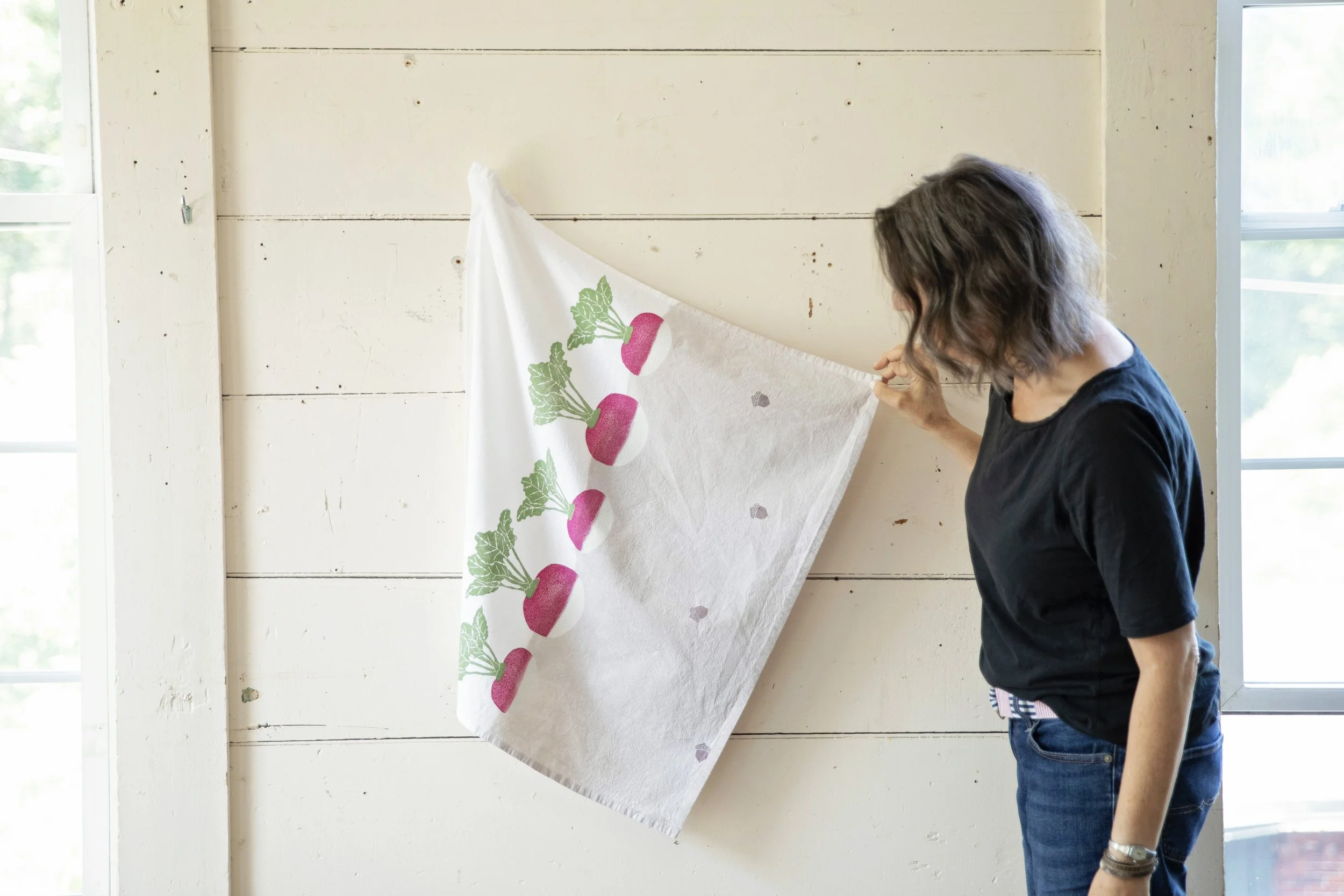
Photo credit: Kyly B Clark
If you find a golden acorn on one of my tags, you’ve discovered something extra special.
It might look like a tiny detail hidden within the pattern, but the acorn has a story to tell. It is my way of celebrating the beautiful imperfections, variations, and surprises that happen when textiles are dyed and printed entirely by hand.
A little imperfection is part of the process
I do everything by hand.
And because I am human, there might be a few mistakes, variations, and happy accidents along the way. Rather than trying to eliminate those differences, I’ve decided to play with them.
For me, they are part of the fun.
From the initial dyeing of the fabric to carving, printing, layering, and finishing the design, every step creates an opportunity for something unexpected. No two hand-dyed or hand-printed pieces are ever perfectly identical, and that is exactly what makes them interesting.
Hand-dyeing fabric evenly, every single time, is surprisingly challenging. The process naturally creates subtle differences in color, texture, and saturation. Those variations are one of the things I love most about working by hand.
Sometimes I even create them intentionally.
When a mistake becomes part of the design
The acorn came from one of those moments.
When I was working on some of my first hand-dyed fabrics, I noticed a few variations in the dyeing. I could have tried to correct them, but instead I started wondering:
What if I made the variation part of the pattern?
That question led to the acorn.
The acorn became a little visual marker, a way of acknowledging that something about this particular print is different.
It also happened to fit beautifully with the imagery I was already exploring.
Inspiration straight from my garden
The idea of placing an acorn beneath a carrot came directly from my own garden.
Every year, when I prepare my garden for the next season, I discover acorns tucked beneath the soil. The squirrels have been busy. They bury their treasures for later, and sometimes I uncover those little surprises months afterward.
So, the image of an acorn hiding beneath a carrot became a tiny piece of real life translated into my textile patterns. It feels very much like the garden itself is leaving me a message. And that is exactly the kind of detail I love to hide in my work.
The golden acorn is a sign of variation
Once I began using the acorn to celebrate variation in my garden-inspired dyeing, I started looking for other ways to incorporate the same idea. In the green “grass” dyeings, the acorn became a way to mark a variation in the color.
In my indigo designs, I use small seashells to mark the ocean floor when the dyeing creates a variation.
The symbols change with the environment, but the idea stays the same: The variation isn't a flaw. It's part of the story.
That philosophy is especially important to me because hand-dyeing and hand-printing are processes where the human hand remains visible. The slight differences in color, placement, pressure, and texture are evidence that a person made the piece.
Keep your eyes open for the acorn
Occasionally, you may even find an acorn hidden within one of my all-over repeat designs. But you won't find one on every piece. That's what makes discovering one so much fun.
When an acorn appears, it means you've found a variation, a piece that is a little different from the others. These rare acorn-marked prints are essentially collectibles and, because they occur only occasionally, are more valuable than traditional prints.
So, the next time you look at one of my hand-printed textiles, don't just look at the overall pattern.
Look closer.
You might find a little acorn hiding in the garden, beneath a carrot, among the grass, or somewhere you least expect it.
And if you do?
You've found the secret.
In a world of mass-produced sameness, I think those differences are worth keeping.
So, if you find an acorn on your print, hold onto it. You found something special.