Clover: A Block-Printed Pattern With a Hidden Binary Message
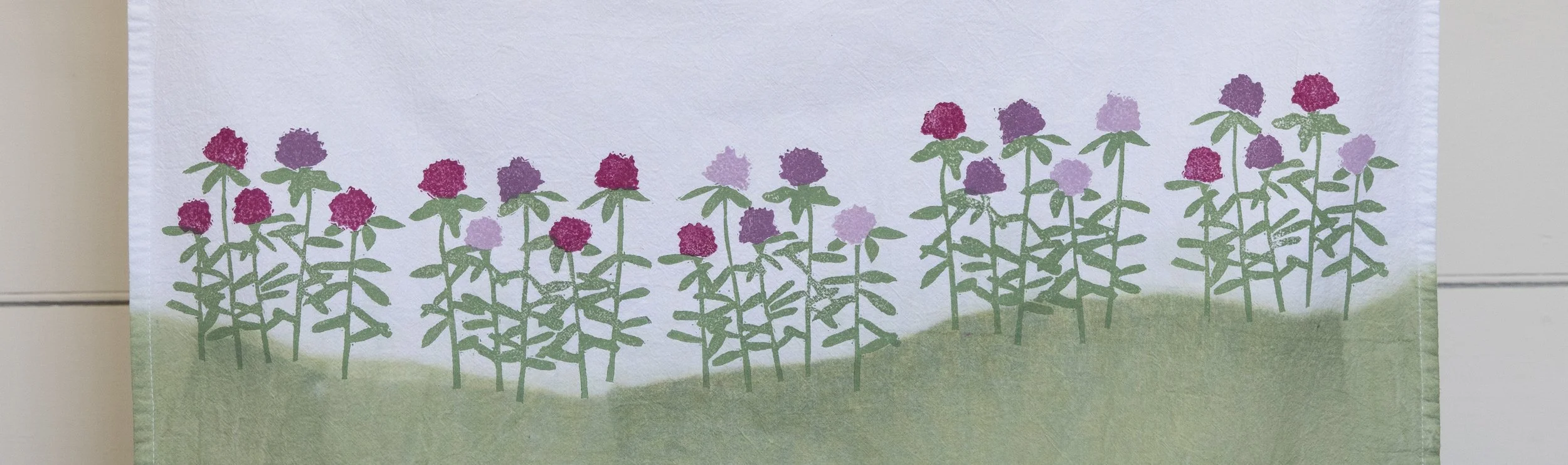
Photo credit: Kyly B Clark
What if a floral pattern could hide a secret message in plain sight?
Clover is my third binary code pattern, but it is the first in which I use two colors to create the binary itself.
For this pattern, I use 5-bit binary as the foundation. The 0s become one color, and the 1s become another. The colors can change, which makes the pattern a little trickier to decipher, but isn't that part of the fun?
What appears to be a simple field of tiny clover blossoms is actually a coded message.
Vermont’s State Flower
The inspiration for this pattern began with a small, familiar flower: red clover, Vermont’s state flower.
Red clover was named Vermont’s official state flower in 1895, though its story began much farther away. It isn’t native to Vermont, or even to New England. Brought over from Europe, it eventually found its way into the landscape and became an important part of farm life, valued for hay and forage. Over time, it became so familiar that it feels as though it has always belonged here.
Today, you can spot red clover in fields, meadows, along roadsides, and in all the little wild places in between.
What draws me to clover is its quiet, almost unassuming beauty. The flowers are tiny, the plants are low to the ground, and from a distance they can easily disappear into a meadow. But pause for a moment and look closely, and there they are, small bursts of red and pink tucked among the green.
That sense of something beautiful waiting to be noticed became the heart of this pattern. I wanted to capture the feeling of wandering through a meadow, slowing down, and discovering details you might otherwise pass by.
Turning Clover Into Code
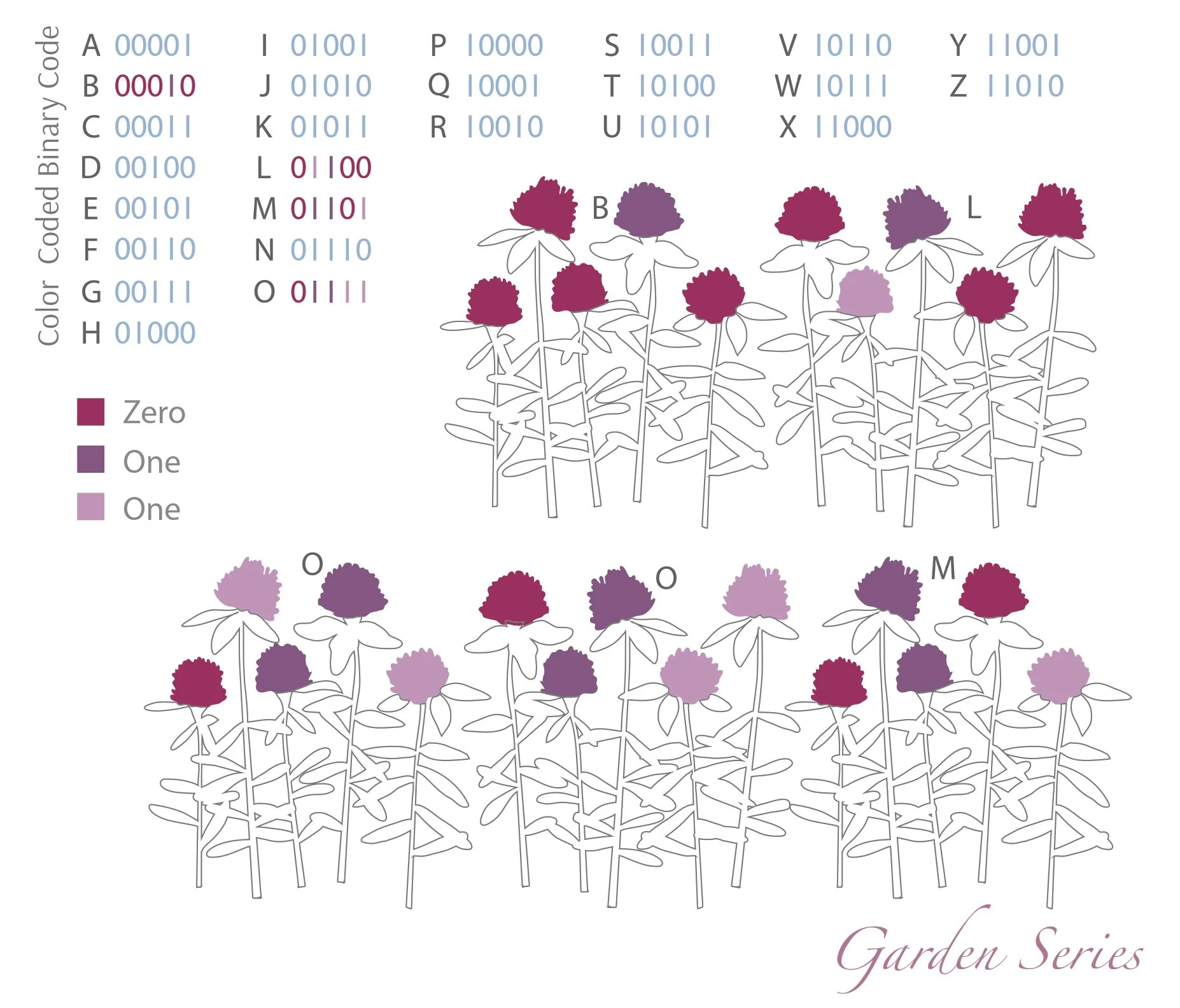
With a 5-bit binary system, each group of five flower heads can represent one letter.
For this pattern, each block contains five clover flower heads. One color represents the 0s, and another represents the 1s. When the five-bit groups are read together, they spell out a hidden word.
But I didn't want the code to be immediately obvious.
To make the pattern more visually complex, I kept the color representing the 0s constant, while the color representing the 1s changes between two different colors. The result is more colorful and makes the underlying binary a little harder to spot.
And again, isn't that part of the fun?
The viewer sees a colorful clover pattern.
The decoder sees something else entirely.
The Hidden Word: BLOOM
This pattern contains five sets of five flower heads, creating one five-letter word:
B L O O M
Each group of five clover blossoms contains the binary information needed to reveal one letter.
The flower heads become the pixels.
The colors become the code.
And the repeating pattern becomes the message.
See the images below to follow along as each letter is decoded.
Decoded message: BLOOM.
From Meadow to Pattern
One of the things I enjoy most about using flowers as the starting point for my textile designs is finding ways to incorporate more than just their appearance.
A flower can carry a place, a history, a language, or, in this case, a code.
The clover pattern may initially look like a traditional botanical print, but once you know there is a message hidden inside it, the flowers become something more. The pattern invites you to slow down, look closely, and start counting.
That is what I love about block printing and surface pattern design: a printed textile can be both beautiful and quietly intellectual.
Clover is one of twenty patterns in my book, Not Just A Pretty Picture: The Art, Process, and Language Behind the Prints, from the studio of Kristen Dettoni.